

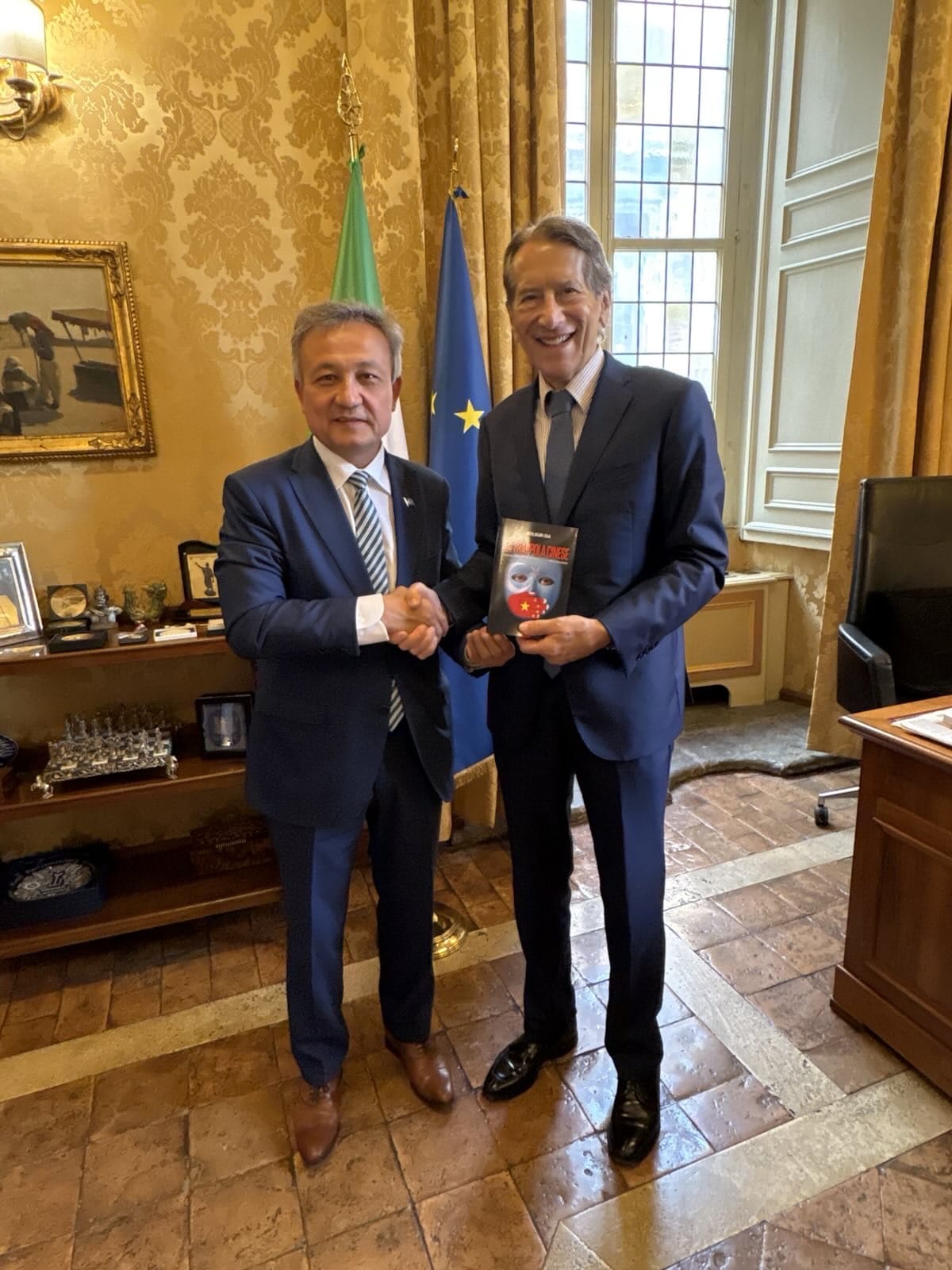
Der Präsident des Weltkongresses der Uiguren, Dolkun Isa, ist nach acht Jahren erneut im italienischen Senat empfangen worden. 2017 war er dort noch vor dem Gebäude verhaftet worden, als er an einer Pressekonferenz teilnehmen wollte.
Now he returned to the same place – this time for an official meeting with Senator Giulio Terzi. During the meeting, Isa presented the report of the Uyghur Tribunal as well as the Italian edition of his book.
Observers view the meeting as an important sign of the growing international attention to the human rights situation of the Uyghurs in China.
Dolkun Isa: “In 2017, I was arrested in front of the Italian Senate while trying to attend a press conference. Today, after eight years, I returned to the same Senate – for a meaningful meeting with Senator Giulio Terzi, during which I presented the report of the Uyghur Tribunal as well as the Italian edition of my book.”:„Im Jahr 2017 wurde ich vor dem italienischen Senat verhaftet, als ich versuchte, an einer Pressekonferenz teilzunehmen. Heute, nach acht Jahren, kehrte ich in denselben Senat zurück – zu einem bedeutungsvollen Treffen mit Senator Giulio Terzi, bei dem ich den Bericht des Uiguren-Tribunals sowie die italienische Ausgabe meines Buches überreichte.“
Giulio Terzi: “It was a great pleasure for me today in the Senate to meet my friend Dolkun Isa, President of the Uyghur Center for Democracy and Human Rights, as well as Zumretay Arkin, Vice President of the World Uyghur Congress. Together with Dolkun, I had already presented his book ‘The Chinese Trap’ in the Sala Nassirya of the Senate in February 2023.
Dolkun informed me about the current human rights situation of his Uyghur community in the Xinjiang region. The violations are becoming increasingly visible: Beijing has intensified the surveillance of nearly the entire Uyghur population through new technologies. The number of arrests and imprisonments has increased, as has the horrific crime of forced organ removals.
In addition, there is a growing indoctrination of Uyghur children in so-called ‘boarding schools,’ similar to what occurs in Tibet. There, young students are forced to learn Mandarin and to give up all contact with their culture and their home region of Xinjiang. The situation of many Uyghur workers has also become known: they are forcibly relocated to distant regions of the People’s Republic to be exploited in various industries under conditions resembling slavery.
In this context, Dolkun Isa’s speeches and reports before the UN Human Rights Council are significant, as they were given due attention; as well as the statements of the current EU High Representative for Foreign Affairs, Kaja Kallas, and the Uyghur Forced Labor Prevention Act, passed by the U.S. Congress in 2021, which effectively restricts the import of products made through the exploitation of Uyghur labor in China—a law that was already enforced during the Trump administration.
Furthermore, the commitment of our Uyghur friends is remarkable, as they confront Beijing’s threats directed worldwide against members of the World Uyghur Congress—often through the misuse of Interpol ‘Red Notices.’
Support for our Uyghur friends must therefore continue without fail!”
Sources: